Costas Arvanitis–Stella marriage
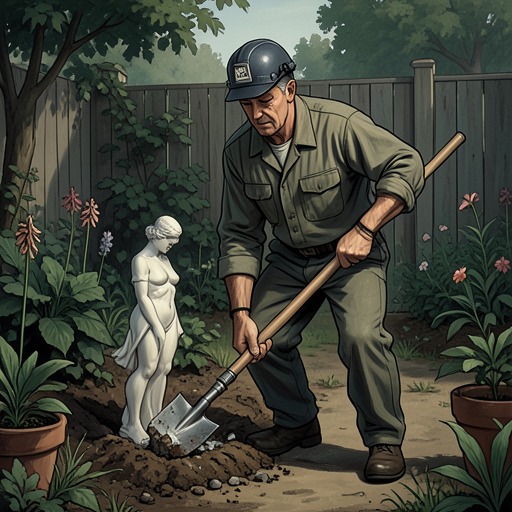
Cartes Postales from GreeceCostas Arvanitis and Stella’s marriage is defined less by open conflict than by the daily repetition of a life lived side by side without meaningful exchange. After decades together and the raising of two children, their shared home has become a place of questions, noise, and separate attention rather than intimacy. Costas’s discovery of the Aphrodite statue briefly awakens a feeling he associates with love and beauty, throwing the long absence of desire in his marriage into sharper relief.
A Marriage Reduced to Routine
The household pattern is established through Costas’s return from the village and Stella’s familiar questions about his lateness, dinner, and errands. She speaks from the scullery, then brings food to the table: one plate before him, another at the far end. Costas eats with his head bent and his eyes on his food. His responses are grunts; there is no conversation. The same arrangement has continued every day for decades, making repetition itself the clearest account of their relationship.
Their shared meals do not create companionship. Stella keeps talking while they eat, and Costas does not look at her. The television adds another competing stream of sound, carrying a loud political debate that neither appears to attend to. In this household, company means physical proximity, not mutual listening. The contrast with Costas’s daytime tranquillity is stark: home at night is noisy, yet the marriage at its center remains emotionally quiet.
Distance, Desire, and the Past
Costas’s recollection of their marriage is organized around a contrast between Stella’s appearance when they married and his later experience of life with her. She had been beautiful at eighteen and still lovely at twenty-five, he remembers. After they had two children, he felt that she no longer cared for herself. His account stresses her changing appearance and declining hygiene as sources of his discomfort, but also shows that his attention to her had itself diminished: he says that he did not look at other people’s wives, yet did not look at his own either.
Their distance had extended to physical intimacy. When Costas encounters the buried sculpture, the memory of touching a woman feels remote to him. He estimates that it has been more than thirty years, perhaps thirty-five, since he last touched Stella or felt desire for her, and cannot identify the time more exactly. The uncertainty matters: the marriage has lasted so long in this condition that even its last moment of intimacy has become indistinct to him. The account records his perspective rather than establishing what Stella felt about their shared life.
The Sculpture as a Late Reversal
The discovery of the Aphrodite statue produces a short-lived change in Costas’s emotional life. His response to the figure leads him to touch it cautiously, and the encounter brings back a feeling he had long associated with desire. The contrast is not between a new human relationship and his marriage: the object of his attention is a sculpture. Rather, its beauty becomes the occasion for an intensity that his domestic life has not supplied for decades.
The narrator later interprets Costas’s feelings as a renewed experience of sexual attraction and says that they gave him a zest for life he had lost. This does not repair his marriage or show a reconciliation with Stella. It instead reveals how little vitality Costas had found in the relationship as he experienced it, and how powerfully a brief encounter with beauty could interrupt that deadened routine. The change belongs to Costas’s inner life; the evidence does not describe a corresponding change in Stella or in their day-to-day relationship.
Death and the Marriage’s Unresolved Ending
After Costas dies, Orestes goes to Stella. She says that Costas must have had a heart attack, and the doctor agrees. Before the funeral, Orestes plans to place a fragment of the Aphrodite statue in the breast pocket of Costas’s only suit, believing that Costas would want it with him. The gesture connects the final rites not to a renewed bond between husband and wife, but to the experience that had briefly restored Costas’s sense of feeling.
The narrator attends the funeral and the family lunch afterward. Stella is dressed in black, but the narrator observes that she does not seem to be grieving more than he is. This is an impression, not proof that Stella feels nothing: the account offers no access to her private thoughts, and her long silence within the marriage does not explain her response to his death. The ending leaves their relationship as it has largely been shown throughout: a shared history and household, but little evidence of mutual disclosure. Costas’s revived sense of desire gives their marriage a late contrast, not a resolution.